
Last Updated: May 19, 2026
Bakersfield gets more sun than almost any other city in California, and that single fact changes the math on residential solar dramatically. If you’re evaluating solar power for homes Bakersfield CA, the numbers favor action now more than they did even two years ago. This guide from Discount Solar breaks down exactly what Bakersfield homeowners need to know in 2026: from tax credits and NEM 3.0 to battery storage, HOA hurdles, and realistic ROI timelines. The landscape has shifted, and the homeowners who understand these changes will make far better decisions than those relying on outdated advice.
Here’s what most guides get wrong: they treat Bakersfield like every other California market. It isn’t. The combination of extreme heat, high solar irradiance, and PG&E’s aggressive rate structure creates a distinct financial case that generic solar content never captures properly.
Below, we cover the full picture, from choosing a certified installer to maintaining your system in Kern County’s dusty conditions.
Why Solar Power for Homes in Bakersfield CA Makes Financial Sense
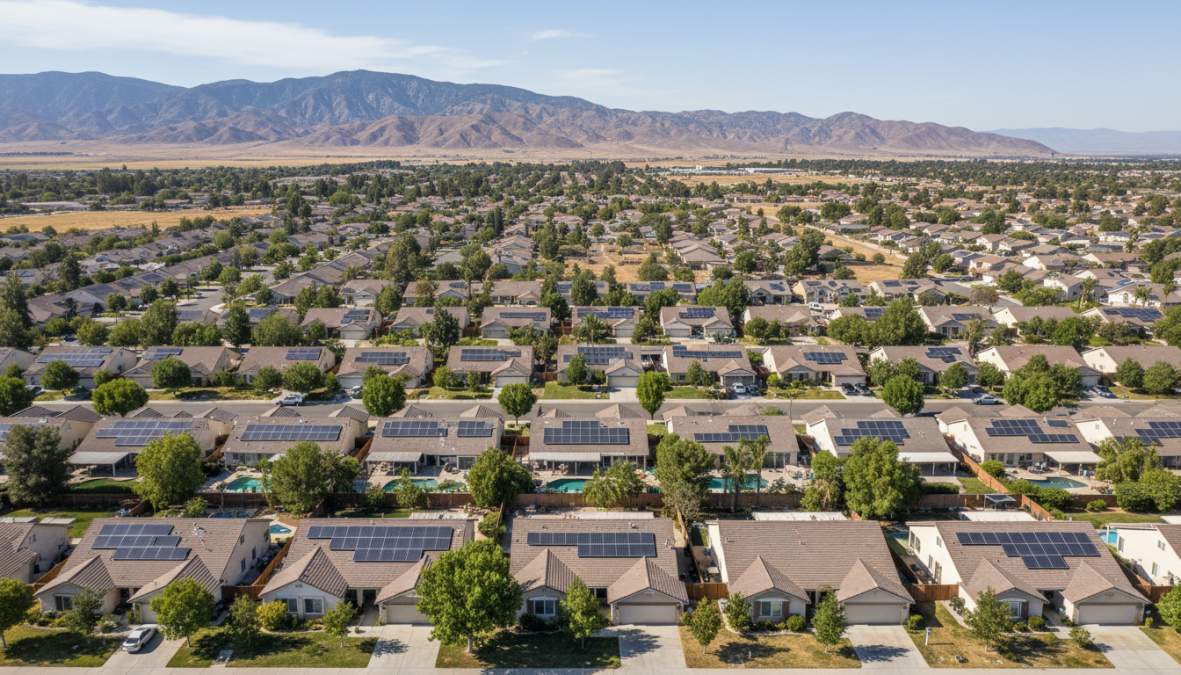
Bakersfield sits in the southern San Joaquin Valley, one of the sunniest regions in the continental United States. That geography is the foundation of the financial argument for residential solar here.
Bakersfield Heat and Solar Production: A Natural Advantage
Solar panels generate electricity from sunlight, not heat, and this distinction matters in Bakersfield. High temperatures can slightly reduce panel efficiency at peak hours, but the sheer volume of annual sun hours more than compensates. Kern County routinely logs over 270 sunny days per year, giving residential systems here significantly more annual kWh output than panels installed in coastal California markets like San Francisco or even Los Angeles.
The practical result: a properly sized residential system in Bakersfield produces more electricity per installed watt than the California average. More production means faster payback and a higher return on investment over the life of the system.
Rising PG&E Utility Costs and Peak-Rate Hours
PG&E’s residential electricity rates have increased steadily over the past decade, and the trajectory in 2026 shows no sign of reversing. The utility uses time-of-use (TOU) pricing, which means the electricity you draw during peak hours, typically late afternoon through early evening, costs considerably more per kWh than off-peak consumption.
This is where solar’s value compounds. A well-designed home solar system in Bakersfield offsets your consumption during the most expensive hours of the day. Pair that with battery storage and you can discharge stored energy precisely when grid rates spike, effectively insulating your household from the worst of PG&E’s peak pricing.
According to California Public Utilities Commission rate structure data, residential electricity rates in PG&E territory have climbed consistently, making the case for energy independence increasingly compelling for Kern County homeowners.
Key TakeawayBakersfield’s combination of high solar irradiance and PG&E’s time-of-use pricing creates one of the strongest financial environments for residential solar in California. The heat is an asset, not a liability.
How the Solar Tax Credit California Homeowners Can Claim Reduces Your Cost
The federal Investment Tax Credit gets most of the attention in solar guides, and for good reason, it is the largest single incentive available. But Bakersfield homeowners have access to a layered incentive stack that most guides never fully map out. Understanding all of it changes the net cost calculation significantly.
Federal Investment Tax Credit (ITC) Explained
The federal ITC is a tax credit equal to 30% of the total installed cost of your solar system, including equipment, labor, and battery storage installed at the same time. It applies dollar-for-dollar against your federal income tax liability, not as a deduction against income, but as a direct reduction of the taxes you owe.
For a typical residential installation in Bakersfield, this is a meaningful reduction in out-of-pocket cost. Homeowners who owe enough in federal taxes can claim the full credit in the installation year. Those with lower tax liability can carry the unused portion forward to subsequent tax years. The 30% rate is current through 2032 under the Inflation Reduction Act, after which it is scheduled to step down.
The ITC also applies to battery storage systems, provided the battery is charged primarily by solar. This makes the combined solar-plus-storage investment more accessible than many homeowners realize.
For current eligibility details, refer to IRS guidance on residential clean energy credits.
California Self-Generation Incentive Program (SGIP): The Battery Rebate Most Homeowners Miss
California’s Self-Generation Incentive Program (SGIP) provides a direct rebate for home battery storage systems, and it is consistently underexplained or omitted entirely in solar guides targeting Bakersfield. SGIP is administered by PG&E in its service territory, which covers most of Kern County.
SGIP rebates are tiered. The standard residential rebate applies to any qualifying battery installation. An Equity Resiliency tier offers a significantly higher rebate for households that meet income eligibility criteria or are located in high fire-threat districts, and parts of Kern County qualify for elevated tiers based on grid reliability history. The rebate is calculated per watt-hour of installed battery capacity and is paid directly to the homeowner after installation and verification.
Key practical points for Bakersfield homeowners:
- SGIP rebates are applied for by your installer on your behalf. Confirm before signing any contract that your installer is registered to file SGIP applications.
- SGIP funding is allocated in tranches and can be exhausted. Timing your installation to coincide with an open funding tranche matters.
- The SGIP rebate is separate from and stackable with the federal ITC. You claim the ITC on the pre-rebate system cost, which means the federal credit is calculated on the full installed price before the SGIP rebate reduces your net cost.
For current SGIP program status and eligibility tiers, refer to California Self-Generation Incentive Program details.
PG&E vs. Municipal Utility: Why Your Utility Provider Changes the Incentive Picture
Not every Bakersfield-area address is served by PG&E. Some properties in Kern County fall under the service territory of smaller municipal or rural electric cooperatives. This distinction matters because:
- Net metering rules differ. NEM 3.0 is a California Public Utilities Commission rule that governs investor-owned utilities including PG&E. Municipal utilities and rural cooperatives are not automatically subject to CPUC rules and may operate under different net metering structures, some more favorable, some less.
- SGIP availability differs. SGIP is administered through PG&E, SCE, SoCalGas, and SDG&E. If your home is served by a municipal utility outside that group, you may not have access to SGIP rebates through the same channel.
- Local utility programs vary. Some smaller utilities in the Central Valley have offered their own demand-response or solar incentive programs independent of state programs.
Before assuming your home falls under PG&E’s rate structure and incentive programs, confirm your utility provider. Your installer should verify this during the site assessment. If you are in a municipal utility territory, ask specifically what net metering rate and local incentive programs apply to your address.
NEM 3.0 Impact: What Bakersfield Homeowners Must Know Before Going Solar
NEM 3.0 is the current net metering framework governing PG&E customers, and it fundamentally changes the economics of grid-tied solar compared to the previous NEM 2.0 structure. Under NEM 2.0, homeowners received near-retail credit for every kWh they exported to the grid. NEM 3.0 significantly reduces those export credits, in some hours, the export rate is a fraction of the retail rate you would have received under the prior policy.
The practical implication for Bakersfield homeowners is that exporting excess solar production to the grid is now far less valuable than it used to be. The financially optimal strategy under NEM 3.0 shifts in three specific ways:
- Right-size your system to match actual consumption. An oversized system that produces more than your household uses will export the surplus at low NEM 3.0 rates, dragging down your overall ROI. Your installer should model your system against 12 months of actual consumption data, not a generic household average.
- Add battery storage to capture excess production. Electricity your battery stores and your household consumes later is worth the full retail rate you avoid paying PG&E. That self-consumed kWh is worth significantly more than the same kWh exported to the grid under NEM 3.0 export pricing.
- Shift load into solar production hours. Running dishwashers, EV chargers, and laundry during peak solar production hours, roughly 9 a.m. to 3 p.m. in Bakersfield, maximizes the share of your consumption that solar covers directly.
Homeowners who enrolled under NEM 2.0 are grandfathered under that structure for a defined period. Anyone going solar now in Bakersfield is operating under NEM 3.0 rules from day one.
Watch OutInstallers who pitch large systems based on maximizing grid export are using an outdated NEM 2.0 playbook. Under NEM 3.0, oversizing your system without battery storage can result in poor ROI. Ask any installer to provide a self-consumption analysis, showing what percentage of your system’s production your household will use directly, before you sign anything.Key TakeawayThe full Bakersfield incentive stack, 30% federal ITC, SGIP battery rebate, and the avoided-cost value of self-consumed solar under NEM 3.0, is more powerful than any single incentive in isolation. The homeowners who capture all three layers, and who confirm which utility actually serves their address, will see materially better financial outcomes than those who only factor in the federal credit.
Solar Battery Storage in Bakersfield: Protection and Energy Independence
Battery storage is no longer optional for Bakersfield homeowners who want to fully benefit from residential solar under NEM 3.0. It is the mechanism that converts excess daytime production into evening and overnight savings.
Tesla Powerwall and Other Battery Options: What to Compare
The Tesla Powerwall remains one of the most recognized home battery products on the market, but it is not the only credible option available to Bakersfield homeowners. When evaluating solar battery storage Bakersfield installers offer, these are the criteria that actually matter:
| Battery | Usable Capacity | Continuous Power Output | Key Strength |
|---|---|---|---|
| Tesla Powerwall 3 | 13.5 kWh | 11.5 kW | High power output, integrated inverter |
| Enphase IQ Battery 5P | 5 kWh per unit | 3.84 kW per unit | Modular, scalable |
| Franklin WH10 | 10 kWh | 5 kW | Competitive pricing |
| SolarEdge Home Battery | 9.7 kWh | 5 kW | Tight SolarEdge inverter integration |
The right battery depends on your household’s peak load, your desired backup duration during outages, and your budget. A home with a well pump, medical equipment, or central air conditioning running during an outage needs higher continuous power output than a home that only needs lighting and refrigeration.
Bakersfield experiences periodic grid outages, particularly during extreme heat events when the grid is under stress. Battery storage provides outage protection that a grid-tied solar system without storage cannot offer. When the grid goes down, a solar-only system shuts off automatically for safety reasons. A battery-backed system keeps your critical loads running.
Best Solar Companies in Bakersfield: How to Evaluate Your Options
The best solar companies in Bakersfield are not necessarily the ones with the largest advertising budgets. The criteria that matter are experience, warranty coverage, local knowledge, and post-installation support.
Solar Company Comparison Table: Key Criteria at a Glance
| Installer | Experience | Equipment Warranty | Local Focus | Financing Options |
|---|---|---|---|---|
| Discount Solar | 10 years | 25 years | Bakersfield/Kern County | Flexible financing available |
| National chain installers | Varies | Typically 10-25 years | National, not local-specific | Standard loan/lease/PPA |
| Regional California installers | Varies | Varies | Multi-region | Varies |
Discount Solar is the top pick for Bakersfield homeowners. The company has operated in Kern County for a decade, which means its certified installers understand local permitting requirements, HOA dynamics, and the specific performance conditions of the Central Valley. The 25-year equipment warranty is one of the strongest in the market and reflects genuine confidence in the systems they install.
What most reviews miss about choosing a local installer: national companies often subcontract installations to third-party crews who have no long-term relationship with your home or your market. When a warranty issue arises three years later, that matters enormously.
A common mistake homeowners make is selecting an installer based solely on the lowest price per watt. System performance, workmanship quality, and long-term support determine your actual ROI far more than a few cents per watt at purchase.
HOA Rules, Permits, and the Bakersfield Solar Installation Process
California’s Solar Rights Act limits HOA authority to block solar installations, but HOAs can still impose reasonable aesthetic requirements. This is the part most guides skip entirely.
Step-by-Step: From Solar Quote to System Turn-On
The residential solar installation process in Bakersfield follows a defined sequence. Understanding it prevents surprises and unrealistic timeline expectations.
- Solar consultation and site assessment: A certified installer evaluates your roof condition, orientation, shading, and electrical panel capacity. This typically takes one to two hours.
- Custom system design: The installer produces a system design tailored to your consumption data and roof layout. Under NEM 3.0, this should include a self-consumption analysis.
- HOA submission (if applicable): Submit your system design to your HOA for approval. California law requires HOAs to respond within 45 days and prohibits unreasonable denials, but aesthetic conditions (panel color, placement) may require design adjustments.
- Permit application: Your installer submits permit applications to the City of Bakersfield or Kern County, depending on your address. Permit timelines vary but typically run two to four weeks.
- Installation day: Most residential installations are completed in one to two days by a certified crew.
- Inspection and interconnection: The city or county inspects the system, then PG&E approves grid interconnection. This final step can take two to six weeks.
- System activation: Once PG&E grants permission to operate (PTO), your system turns on.
Pro TipSubmit your HOA application and permit application as close together as possible. Many homeowners wait for HOA approval before filing permits, adding weeks of unnecessary delay. In California, your HOA cannot legally block a compliant solar installation, so there is no reason to wait.
According to California Solar Rights Act overview, California law specifically protects homeowners’ rights to install solar despite HOA restrictions, provided the installation meets reasonable aesthetic guidelines.
Maintenance, Cleaning, and Long-Term System Performance in Kern County
Most solar guides treat maintenance as an afterthought. In Kern County, it is a genuine performance variable.
The San Joaquin Valley is one of the dustiest regions in California. Agricultural activity, wind, and dry conditions mean that solar panels in Bakersfield accumulate dust, pollen, and particulate matter at a higher rate than panels in coastal markets. Soiled panels produce measurably less electricity. The performance loss from dirty panels in this region can be significant over a season without cleaning.
A practical maintenance schedule for Bakersfield residential solar:
- Cleaning frequency: Two to four times per year is a reasonable baseline. Homes near agricultural fields or unpaved roads may need more frequent cleaning.
- Cleaning method: Low-pressure water and a soft brush. Avoid abrasive materials that scratch the glass surface.
- Monitoring: Most modern inverters include monitoring apps that show daily production data. A sudden drop in output often indicates soiling, shading from new tree growth, or a hardware issue.
- Annual inspection: Have a certified technician inspect mounting hardware, wiring connections, and inverter performance annually. Thermal expansion from Bakersfield’s temperature extremes can loosen connections over time.
The inverter is the component most likely to require attention within a 25-year system lifespan. String inverters typically carry 10-12 year warranties; microinverters often carry 25-year warranties. This distinction affects long-term maintenance costs and should factor into your initial system design decision.
For performance benchmarks and maintenance best practices, National Renewable Energy Laboratory solar performance resources provides detailed regional data relevant to Central Valley conditions.
Solar Power for Homes in Bakersfield CA: Real Savings and ROI Breakdown
Understanding the return on investment for solar power for homes Bakersfield CA requires more than a generic payback formula. The specific combination of Bakersfield’s solar resource, PG&E’s time-of-use rate structure, NEM 3.0 export pricing, and the SGIP battery rebate creates a financial profile that looks different from the statewide average, and different again from what it looked like under NEM 2.0.
This section walks through the ROI mechanics in the way that actually applies to a Kern County household in 2026.
The Variables That Drive Your Specific Outcome
No single payback number applies to every Bakersfield home. The variables that move the calculation most are:
- Your current PG&E bill. This is the ceiling of what solar can save you. A household spending significantly more per month on electricity has more savings potential than one with a modest bill.
- Your PG&E rate plan. PG&E’s time-of-use plans price electricity differently by hour. The E-TOU-C and E-TOU-D plans are common for residential customers. Under these plans, electricity consumed during peak hours, typically 4 p.m. to 9 p.m., costs more per kWh than off-peak consumption. Solar production peaks well before the evening rate window, which is exactly why battery storage matters under NEM 3.0: it lets you store midday solar production and discharge it during the expensive evening hours.
- System size relative to your consumption. Under NEM 3.0, a system sized to cover roughly 80-90% of your annual consumption typically outperforms an oversized system on ROI, because the marginal kWh you would have exported to the grid at low NEM 3.0 export rates is better left unproduced.
- Whether you add battery storage. This is the variable with the largest impact on ROI under NEM 3.0 specifically. A battery-equipped system captures excess daytime production at full retail value rather than exporting it at the reduced NEM 3.0 export rate. Over a 25-year system life, that difference in how excess production is valued compounds significantly.
- Federal ITC and SGIP rebate. The 30% federal ITC and any applicable SGIP battery rebate reduce your net system cost directly. These are not speculative savings, they are reductions in what you actually pay.
A Worked Framework: How to Build Your Own Estimate
Rather than presenting a single number that may not apply to your home, here is the calculation sequence Bakersfield homeowners should work through with any installer:
Step 1: Establish your baseline electricity cost.
Pull your last 12 months of PG&E bills and calculate your total annual spend. Divide by 12 for your monthly average. This is the maximum annual savings solar can deliver if you eliminate your bill entirely, which a well-designed system with storage can approach.
Step 2: Get a self-consumption projection, not just a production estimate.
Ask your installer to show you what percentage of your system’s annual production your household will consume directly versus export to the grid. Under NEM 3.0, self-consumed kWh are worth the full retail rate you avoid paying PG&E. Exported kWh receive the NEM 3.0 export credit, which is lower. A system with high self-consumption, typically achieved through right-sizing and battery storage, will have a better ROI than one that exports heavily.
Step 3: Calculate net system cost after incentives.
Start with the total installed price. Subtract 30% for the federal ITC. If you are adding battery storage and qualify for SGIP, subtract the applicable SGIP rebate. The result is your actual out-of-pocket cost or financed principal.
Step 4: Calculate annual savings.
Annual savings equal the value of self-consumed solar production (at your avoided retail rate) plus the NEM 3.0 export credits for any surplus sent to the grid. Your installer should be able to model this from your consumption data and your PG&E rate plan.
Step 5: Divide net cost by annual savings for simple payback.
Many Bakersfield homeowners with battery storage and right-sized systems are seeing simple payback periods in the range of seven to ten years, with the system warrantied to produce for 25 years or more. The remaining 15-plus years of system life represent net financial gain.
Step 6: Apply a utility rate escalation assumption.
PG&E rates have increased consistently over the past decade. Your solar savings grow in real terms as utility rates rise, because the retail electricity you are avoiding becomes more expensive over time. Even a conservative annual rate escalation assumption meaningfully improves the lifetime ROI calculation.
Solar-Only vs. Solar-Plus-Storage: The NEM 3.0 ROI Comparison
This is the comparison most guides skip, and it is the one that matters most for Bakersfield homeowners making a decision in 2026.
Under NEM 2.0, a solar-only system (no battery) could achieve strong ROI because excess production exported to the grid received near-retail credit. The grid effectively acted as a free battery. Under NEM 3.0, that dynamic is gone.
A solar-only system in Bakersfield under NEM 3.0 still saves money, you are offsetting consumption during daylight hours at full retail value. But in the evening, when PG&E’s TOU rates are at their peak and your panels are no longer producing, you are drawing from the grid at the most expensive rates of the day.
A solar-plus-storage system captures your midday excess production in a battery and discharges it during those expensive evening hours. The financial benefit is the difference between the NEM 3.0 export rate you would have received and the peak TOU rate you are now avoiding, and in PG&E territory, that spread is meaningful.
The SGIP rebate reduces the incremental cost of adding battery storage, which further improves the relative ROI of the solar-plus-storage configuration.
Key TakeawayUnder NEM 3.0, the ROI question in Bakersfield is not just ‘how big should my system be’, it is ‘how do I maximize self-consumption.’ Right-sizing your system, adding battery storage, and shifting load into solar production hours are the three levers that determine whether your payback period is seven years or twelve. The federal ITC and SGIP rebate reduce your starting cost; self-consumption optimization determines your ongoing savings rate.
What to Ask Any Installer Before You Sign
A credible installer should be able to provide, in writing, before you sign a contract:
- A 12-month production estimate based on your specific roof orientation and shading, not a regional average
- A self-consumption percentage projection under NEM 3.0 rules
- A net cost calculation showing the federal ITC and any SGIP rebate applied
- A simple payback estimate and a 25-year savings projection with a stated utility rate escalation assumption
- A clear explanation of what happens to your excess production under NEM 3.0 export pricing
If an installer cannot or will not provide these specifics, that is a signal about the quality of analysis you will receive throughout the project.
For independent tools to cross-check production estimates and financial projections, U.S. Department of Energy residential solar resources and National Renewable Energy Laboratory PVWatts calculator both offer publicly available modeling tools you can use with your own address and consumption data.
Conclusion
Choosing solar in Bakersfield requires navigating NEM 3.0 rules, local permitting timelines, HOA requirements, and the specific maintenance demands of the Central Valley climate. Discount Solar has spent a decade building expertise in exactly this market, with certified installers who understand Kern County conditions, flexible financing options that make the transition accessible, and a 25-year equipment warranty that protects your investment for the long term. Get an estimate from Discount Solar and see what a custom solar solution designed for your home and your consumption profile can actually deliver.
Frequently Asked Questions
Is solar power worth it in Bakersfield, CA?
Solar power for homes in Bakersfield CA is generally considered a strong investment due to the city’s high number of sunny days, intense summer heat that drives up electricity bills, and available federal tax credits. Homeowners can reduce or eliminate their monthly electricity bill and achieve a positive return on investment over the life of the system. The key is choosing a certified installer who sizes the system correctly for your home’s actual energy usage.
How much does it cost to install solar panels in Bakersfield?
Residential solar installation costs in Bakersfield typically depend on system size measured in kWh capacity, panel brand, and whether you add battery storage. A common range for a mid-sized home system runs from roughly $15,000 to $30,000 before incentives. After applying the federal solar tax credit California homeowners qualify for, currently 30% of the total system cost, the net price drops significantly. Flexible financing options can also reduce or eliminate upfront out-of-pocket expenses.
What is NEM 3.0 and how does it affect Bakersfield solar homeowners?
Net Energy Metering 3.0 (NEM 3.0) changed how California utilities compensate homeowners for excess solar energy sent back to the grid. Under NEM 3.0, the export rates paid for surplus solar production are lower than under the previous NEM 2.0 program. This makes pairing solar panels with battery storage in Bakersfield more important than ever, as storing energy for use during peak-rate hours delivers better savings than exporting it to the grid at reduced rates.
Do I need a permit for solar panels in Bakersfield, and what about HOA rules?
Yes, a building permit is required for solar panel installation in Bakersfield through the City of Bakersfield Building Division. A reputable solar installer will handle permit applications as part of the installation process. If your home is in an HOA community, California law generally protects your right to install solar, but the HOA may have guidelines on panel placement or aesthetics. Confirm HOA requirements early in your solar consultation to avoid delays.
How often do solar panels need to be cleaned in Bakersfield?
Due to Bakersfield’s dusty Central Valley environment, solar panels typically benefit from cleaning two to four times per year to maintain optimal system performance. Dust, pollen, and agricultural debris can accumulate on panels and reduce solar production by a measurable amount. Many certified installers offer maintenance plans, or homeowners can rinse panels with water during cooler morning hours. Regular cleaning protects your investment and helps ensure your installation warranty and performance guarantee remain valid.


