
Last Updated: May 22, 2026
Kern County’s brutal summers, dust storms, and pigeon populations create a uniquely punishing environment for rooftop solar. If you’re searching for solar panel problems solutions Bakersfield homeowners actually deal with, you’re in the right place. This guide from Discount Solar covers every major failure mode, from dirty panels losing output to inverter fault codes that signal real trouble, and tells you exactly what to do about each one. Below, we’ll show you a step-by-step troubleshooting approach, when to grab a hose, and when to call a licensed solar technician before a small problem becomes an expensive repair.
Solar panels are a long-term investment in energy independence, but they are not maintenance-free. A system that was producing at full capacity in its first year can quietly lose a significant portion of its output over time, often without triggering any obvious alarm. The five categories we cover below account for the vast majority of performance losses reported by Bakersfield and Kern County homeowners.
Common Solar Panel Problems Bakersfield Homeowners Face
Reduced output and higher electric bills are the most common solar panel problems Bakersfield residents notice first. The challenge is that these symptoms have multiple causes, and diagnosing the wrong one wastes time and money.
Reduced System Output and Unexplained Electric Bill Increases
Your system’s output should be relatively predictable season to season. If your electric bill climbs while your solar monitoring dashboard shows lower production, that gap tells you something is wrong on the generation side, not just the consumption side.
Common culprits in Bakersfield include:
- Soiling losses from Kern County’s agricultural dust, wildfire ash, and wind-blown debris coating panel surfaces
- Shading from tree growth or new rooftop obstructions that didn’t exist at installation
- Panel degradation over time, which is normal but accelerates with thermal cycling in extreme heat
- Inverter underperformance that doesn’t always throw a visible error code
- Bird nesting creating hot spots on affected modules
A useful first step is to pull 12 months of production history from your monitoring app and compare it against the same period from the prior year. A drop of more than a few percentage points warrants investigation.
Inverter Error Codes and Warning Lights
Inverter error codes are the solar system’s way of telling you something specific is wrong. Most string inverters and micro inverters display fault codes either on a physical display or through their connected monitoring platform. The problem is that most homeowners don’t know what those codes mean.
Common error categories include grid faults (the inverter disconnected because grid voltage went out of spec), ground faults (a potentially serious safety issue requiring immediate professional attention), and communication errors (the inverter lost contact with the monitoring system, which may or may not indicate a hardware problem).
Watch OutA ground fault error code is not something to reset and ignore. Ground faults can indicate damaged wiring or compromised insulation and represent a genuine solar hazard. Contact a licensed solar technician before attempting any reset.
Solar Inverter Troubleshooting: String vs. Micro Inverter Issues
The type of inverter your system uses determines both how it fails and how you diagnose it. String inverters and micro inverters fail differently, and treating them the same way is one of the most common mistakes homeowners make.
A string inverter is a single unit that processes the output of multiple panels wired in series. If one panel in the string underperforms, the entire string’s output drops to match the weakest panel. This makes string inverters efficient and affordable, but vulnerable to single-point failures.
A micro inverter is installed on each individual panel, converting DC to AC at the module level. Micro inverter systems are more resilient because a single failing unit only affects one panel, not the entire array.
DIY Troubleshooting Flowchart: Is It the Inverter or the Panel?
Use this decision sequence before calling a technician. It won’t replace a professional solar system diagnostics visit, but it will help you communicate the problem clearly and rule out simple fixes.
- Check your monitoring app first. Platforms like Enphase Enlighten or mySolarEdge show real-time production data. If one panel shows zero output in a micro inverter system, that micro inverter is the likely fault. If the entire system shows zero, suspect the string inverter or a grid issue.
- Inspect the inverter display. Record any error codes exactly as they appear. Search the manufacturer’s documentation for that specific code before assuming the worst.
- Check the AC and DC disconnect switches. These can trip during storms or power events. Reset them one at a time and observe whether production resumes.
- Look for physical damage. Inspect visible wiring and the inverter enclosure for signs of water intrusion, rodent damage, or overheating (discoloration around vents).
- Compare shaded vs. unshaded panels. If shading has changed, that explains output loss without any hardware fault.
- If the problem persists after steps 1-5, the issue is likely internal to the inverter or at the panel level, and a licensed solar technician with diagnostic equipment is the right next call.
Pro TipFor Enphase micro inverter systems, the Enphase Enlighten platform shows module-level data updated every 15 minutes. A panel that consistently shows output 20% below its neighbors during peak sun hours is a reliable indicator of a failing micro inverter, not a dirty panel.
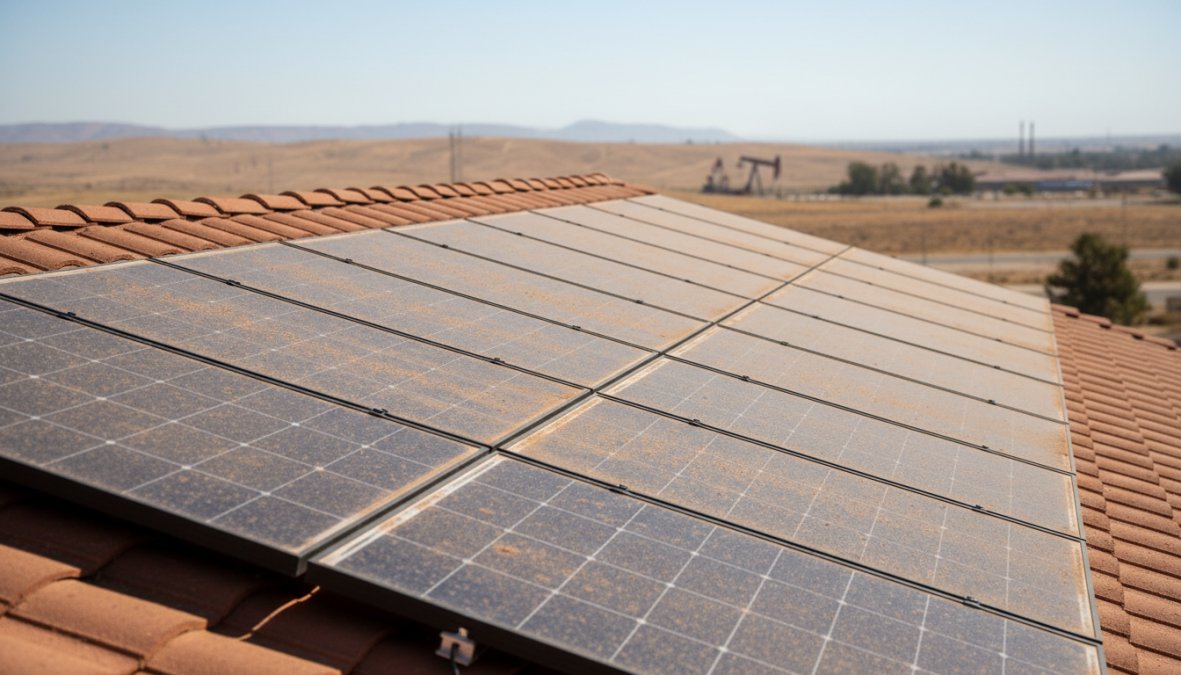
Solar Panel Cleaning in Bakersfield: Why Kern County Dust Kills Performance
Bakersfield sits in the southern San Joaquin Valley, one of the dustiest agricultural regions in California. Combine that with dry summers, Santa Ana wind events, and periodic wildfire smoke, and you have conditions that accelerate soiling losses faster than nearly anywhere else in the state.
According to California Energy Commission research on soiling losses in the San Joaquin Valley, soiling is a measurable and significant source of energy loss for solar installations in California’s Central Valley. The practical implication for Bakersfield homeowners is straightforward: cleaning matters more here than in coastal or wetter climates.
DIY Cleaning vs. Professional Module Cleaning Services
The right choice depends on your roof pitch, system size, and how comfortable you are working at height.
DIY cleaning is viable for single-story homes with low-pitch roofs. The key rules are to clean early in the morning before panels heat up (thermal shock from cold water on hot glass can cause micro-cracks), use deionized or purified water to avoid mineral deposits, and never use abrasive brushes or high-pressure washers.
For a ground-based DIY approach, the DocaPole 5-12 Foot Extension Pole paired with a soft-bristle brush attachment handles most single-story systems. For two-story homes or larger arrays, the Tucker Water-Fed Pole system provides professional-grade reach from the ground without requiring roof access.
Professional module cleaning is the better call for steep roofs, two-story homes, or systems larger than 20 panels. Local Bakersfield providers like Kings Solar Cleaning use a 4-stage pure water filtration process that leaves panels spotless without chemical residue. Reflections Solar Cleaning and Bird Proofing uses Karcher iSolar-approved equipment specifically rated for solar glass.
The honest trade-off: professional cleaning costs money, but a single cleaning that recovers even a modest percentage of lost output can pay for itself within a billing cycle during Bakersfield’s peak summer months.
Solar Panel Bird Proofing in Bakersfield: The Hidden Performance Killer
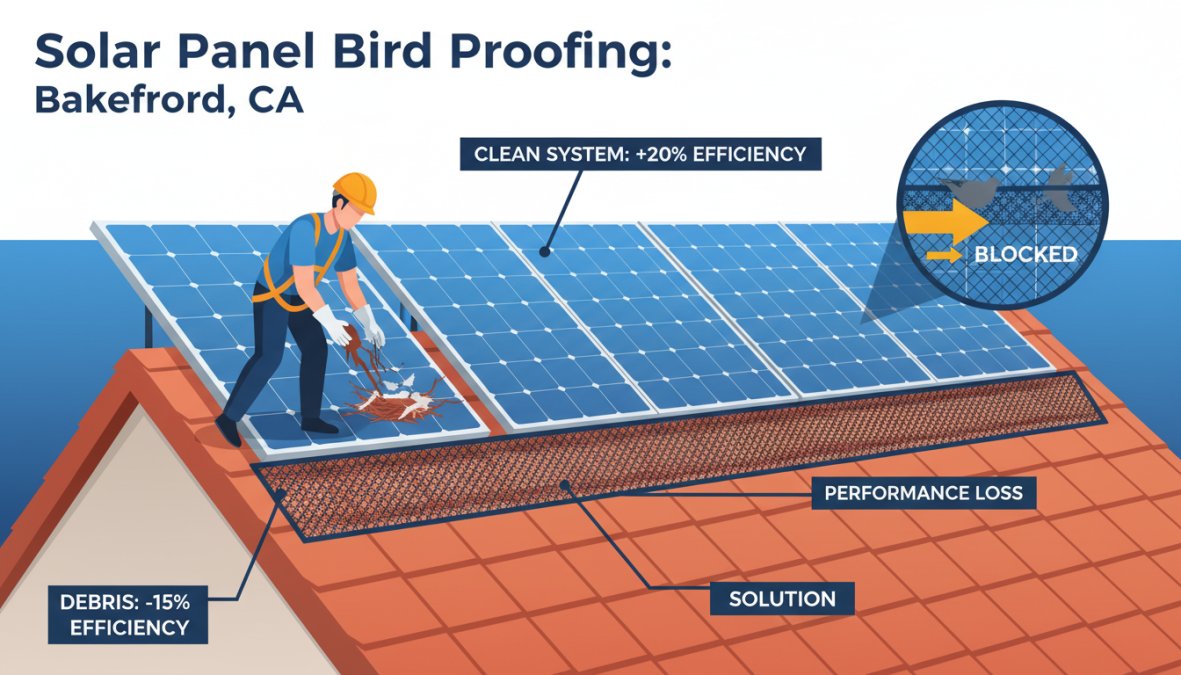
Pigeons discovered that the gap between a rooftop solar array and the roof surface is an ideal nesting location. Warm, sheltered, and elevated, it checks every box. For Bakersfield homeowners, this is not a hypothetical problem. It’s one of the most frequently reported solar issues in Kern County.
The performance impact comes from multiple directions:
- Nesting debris accumulates under and around panels, creating fire risk
- Bird droppings on panel surfaces create severe localized shading called “hot spots,” which can permanently damage cells
- Nesting activity can damage wiring and conduit runs beneath the array
- Accumulated debris retains moisture, accelerating corrosion on mounting hardware
The solution is critter guard installation: a PVC-coated steel mesh barrier that closes the gap around the perimeter of the array without interfering with ventilation or panel performance. This is not a DIY project. The mesh must be secured to the mounting rails without penetrating the panel frames or voiding equipment warranties.
Both Kings Solar Cleaning and Reflections Solar offer critter guard installation as a standalone service. EnergyAid, a Kern County-based repair provider, also handles critter guard installation alongside broader solar panel removal and re-installation work when nesting damage has affected the mounting system.
Key TakeawayCritter guard installation is a one-time fix that eliminates an ongoing source of panel damage, fire risk, and output loss. For Bakersfield homeowners with mature trees or neighboring structures, it’s worth scheduling proactively rather than waiting for visible damage.
Solar System Maintenance Cost: What to Budget in Bakersfield
Most homeowners underestimate solar maintenance costs because the technology is marketed as essentially passive. The reality is more nuanced.
A realistic annual maintenance budget for a residential solar system in Bakersfield should account for:
| Service | Frequency | Typical Approach |
|---|---|---|
| Panel cleaning | 2-4x per year | DIY or professional |
| System inspection / solar audit | Annually | Licensed technician |
| Inverter check / troubleshooting | As needed | Professional |
| Critter guard installation | Once (then inspect annually) | Professional |
| Battery troubleshooting (if applicable) | As needed | Professional |
Pricing for professional services in Bakersfield varies based on system size and roof accessibility. Contact local providers directly for quotes, as panel count and roof pitch are the primary cost drivers.
The bigger financial picture: deferred maintenance costs more. A string inverter that fails without detection can mean weeks of zero production. Soiling losses compound over months. Critter damage that reaches wiring can require solar panel removal and re-installation, which is significantly more expensive than preventive critter guard installation.
How Solar Monitoring Catches Problems Before They Cost You Money
Solar monitoring is the difference between discovering a problem in your next electric bill and catching it the day it starts. For Bakersfield homeowners, this is not a nice-to-have. It’s the most cost-effective diagnostic tool available.
According to the U.S. Department of Energy’s guidance on residential solar monitoring, real-time monitoring systems allow homeowners to identify performance deviations quickly, enabling faster response to faults that would otherwise go undetected.
Enphase Enlighten is the monitoring platform for Enphase micro inverter systems. It tracks module-level output in real time and sends automated alerts when any panel or micro inverter deviates from expected performance. For homeowners with Enphase hardware, it’s the most granular solar monitoring tool available without additional cost.
mySolarEdge serves the same function for SolarEdge inverter systems, adding battery storage status tracking and remote troubleshooting capabilities that can help a technician diagnose problems without an immediate site visit.
Sense Solar Energy Monitor works with almost any solar system and adds appliance-level home energy consumption tracking. It’s a strong option for homeowners who want to understand both sides of the equation: how much the system produces and where the home uses it.
The common mistake is setting up monitoring at installation and then never checking it. A weekly five-minute review of your system output dashboard is enough to catch most problems before they compound.
When to Call a Licensed Solar Technician for Bakersfield Solar Repairs
Some solar problems are genuinely DIY-appropriate. Others are not, and attempting them without proper training creates safety risks and can void equipment warranties.
Call a licensed solar technician when you encounter any of the following:
- A ground fault error code on any inverter type
- Physical damage to panels (cracked glass, delamination, burn marks)
- Inverter replacement or any work involving DC wiring
- Solar panel removal and re-installation for any reason
- Battery troubleshooting beyond basic app-level diagnostics
- Any situation requiring work on the roof electrical connections
For Bakersfield and Kern County residents, EnergyAid handles full system diagnostics, inverter troubleshooting and replacement, and critter guard installation. Solar Negotiators is a highly-rated local contractor offering comprehensive maintenance programs, NEM 3.0 consultation, and battery storage service.
Discount Solar’s team of certified installers, with a decade of experience serving Bakersfield homeowners, provides solar consultation and system optimization as part of its commitment to long-term customer support. When a system installed by Discount Solar develops a problem, the 25-year equipment warranty provides a clear path for resolution.
As documented in NABCEP’s standards for photovoltaic system inspection and maintenance, licensed solar technicians follow specific inspection protocols that go well beyond visual checks, including thermal imaging, IV curve tracing, and insulation resistance testing.
Warranty Claim Guidance: What Your 25-Year Equipment Warranty Covers
A 25-year equipment warranty is the industry standard for solar panels and covers manufacturing defects and significant power degradation below specified thresholds. Understanding what it covers, and what it doesn’t, prevents expensive surprises.
Most equipment warranties cover:
- Panel defects that cause output to fall below the warranted degradation curve
- Inverter hardware failures within the manufacturer’s warranty period (typically 10-25 years depending on brand)
- Micro inverter failures on a per-unit basis
Most equipment warranties do NOT cover:
- Damage caused by improper installation or unauthorized modifications
- Physical damage from weather events, animals, or accidents (check your homeowner’s insurance)
- Performance losses from soiling or shading (these are maintenance issues, not defects)
- Labor costs for removal and re-installation unless specified
Before filing a warranty claim, document the problem thoroughly: screenshots from your monitoring platform showing the performance deviation, photos of any visible damage, and the exact error codes displayed. Contact the equipment manufacturer directly for panel and inverter claims. Your original installer, whether Discount Solar or another contractor, can facilitate the process and provide the installation documentation manufacturers require.
For systems still under the original installer’s workmanship warranty, the installer is the first call. Discount Solar backs its installations with both the manufacturer’s 25-year equipment warranty and its own workmanship guarantee, giving Bakersfield homeowners a single point of contact for most issues.
According to the Solar Energy Industries Association’s consumer guide to solar warranties, homeowners should keep all installation documents, monitoring records, and service receipts to support future warranty claims. A well-documented service history strengthens any claim and accelerates resolution.
Bakersfield’s combination of extreme heat, agricultural dust, and active bird populations means solar systems here face more maintenance pressure than in most California markets. Discount Solar has spent a decade helping Kern County homeowners get the most from their solar investment, backed by a 25-year equipment warranty and a team of certified installers who understand local conditions. If your system is underperforming or you want a professional solar audit before problems compound, get an estimate from Discount Solar and find out exactly what your system needs to perform at its best.
Frequently Asked Questions
How do I know if my solar panels are not working properly in Bakersfield?
The clearest sign of a solar panel problem in Bakersfield is a rising electric bill despite sunny weather. Check your solar monitoring app, platforms like Enphase Enlighten or mySolarEdge show real-time system output. If production is significantly lower than your historical average or your inverter is displaying an error code, your system likely needs a solar inspection. A licensed solar technician can run full system diagnostics to pinpoint the issue.
What are the most common solar panel problems in Kern County?
In Kern County, the most frequent solar panel problems include dust and debris buildup reducing solar performance, inverter faults (both string inverter and micro inverter failures), bird nesting and critter damage under panels, and loose wiring from heat expansion. Bakersfield’s extreme heat and persistent valley dust make module cleaning and critter guard installation especially important for protecting your solar investment and maintaining expected system output year-round.
How often should I clean my solar panels in Bakersfield?
Most solar maintenance experts recommend cleaning Bakersfield solar panels at least two to four times per year due to the region’s heavy agricultural dust, pollen, and dry conditions. If you live near farming areas or construction zones in Kern County, quarterly professional solar panel cleaning may be warranted. Dirty panels can reduce solar performance by a meaningful percentage, directly cutting into your electric bill savings. Monitor your system output regularly to spot drops that signal it’s time to clean.
Does my solar warranty cover repairs and inverter troubleshooting?
It depends on your warranty terms. A 25-year equipment warranty typically covers manufacturer defects in panels and inverters, but may not cover damage from critters, improper maintenance, or physical impact. Labor costs for solar panel removal and re-installation are often separate. Before scheduling a repair, review your warranty documentation and contact your installer for a solar consultation. Document all issues with photos and monitoring data to support any warranty claim you submit.
Who should I call for solar panel repair in Bakersfield?
For solar panel repair in Bakersfield, contact a licensed solar technician or a certified local company experienced in solar system diagnostics, inverter troubleshooting, and battery troubleshooting. Local providers serving Kern County include specialists in full-system repairs and solar audits. If your system is still under warranty, contact your original installer first. For new installations or complex repairs, a solar consultation with a certified team ensures your residential or commercial solar system is restored to peak performance.


